Mostrar el registro sencillo del ítem
Hydroscapes: A useful metric for distinguishing Iso-/Anisohydric behavior in almond cultivars
| dc.contributor.author | Álvarez, Carolina | |
| dc.contributor.author | Acevedo Tapia, Manuel | |
| dc.contributor.author | Pinto, Manuel | |
| dc.date.accessioned | 2021-06-29T15:23:04Z | |
| dc.date.available | 2021-06-29T15:23:04Z | |
| dc.date.issued | 2021 | |
| dc.identifier.citation | Álvarez-Maldini, C.; Acevedo, M.; Pinto, M. Hydroscapes: A Useful Metric for Distinguishing Iso-/Anisohydric Behavior in Almond Cultivars. Plants 2021, 10, 1249. https://doi.org/10.3390/plants10061249 | es_CL |
| dc.identifier.other | https://doi.org/10.3390/plants10061249 | es_CL |
| dc.identifier.uri | https://bibliotecadigital.infor.cl/handle/20.500.12220/30460 | |
| dc.description | 10 páginas | es_CL |
| dc.description.abstract | As a consequence of climate change, water scarcity has increased the use of the iso-/anisohydric concept with the aim of identifying anisohydric or drought-tolerant genotypes. Recently, Meinzer and colleagues developed a metric for discriminating between iso- and anisohydric behavior called the hydroscape, which describes a range in which stomata control leaf water potential (Y) with decreasing water availability, and it is linked to several water-regulation and drought-tolerance traits. Thus, our objective was to test the usefulness of the hydroscape in discriminating between iso- and anisohydric Prunus dulcis cultivars, a species that is widely cultivated in Mediterranean central Chile due to its ability to withstand water stress. Through a pot desiccation experiment, we determined that the hydroscape was able to discriminate between two contrasting Prunus cultivars; the more anisohydric cultivar had a hydroscape 4.5 times greater than that of the other cultivar, and the hydroscape correlated with other metrics of plant water-use strategies, such as the maximum range of daily Y variation and the Y at stomatal closure. Moreover, the photosynthesis rates were also differently affected between cultivars. The more isohydric cultivar, which had a smaller hydroscape, displayed a steeper photosynthesis reduction at progressively lower midday Y. This methodology could be further used to identify drought-tolerant anisohydric Prunus cultivars. | es_CL |
| dc.language.iso | en | es_CL |
| dc.publisher | MDPI | es_CL |
| dc.subject | Estres de sequia | es_CL |
| dc.subject | Potencial hidrico foliar | es_CL |
| dc.subject | Resistencia a la sequia | es_CL |
| dc.subject | Almendra | es_CL |
| dc.title | Hydroscapes: A useful metric for distinguishing Iso-/Anisohydric behavior in almond cultivars | es_CL |
| dc.type | Artículo de revista | |
| infor.publicadoen | Plants 2021, 10, 1249 | es_CL |
| infor.sede | Sede Bio-Bio | es_CL |
| infor.especie | Prunus dulcis | es_CL |
| infor.operador | plv | es_CL |
| infor.lineasdeinvestigacion | Restauración y Manejo Ecosistémico de Recursos Forestales Nativos | es_CL |
Ficheros en el ítem

Este ítem aparece en la(s) siguiente(s) colección(ones)
Ítems relacionados
Mostrando ítems relacionados por Título, autor o materia.
-
Examining physiological, water relations, and hydraulic vulnerability traits to determine anisohydric ...
(Frontiers, 2022)The search for drought tolerant species or cultivars is important to address water scarcity caused by climate change in Mediterranean regions. The anisohydric–isohydric behavior concept has ... -
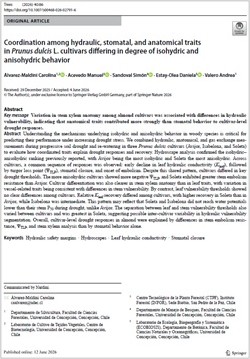
Coordination among hydraulic, stomatal, and anatomical traits in Prunus dulcis L. cultivars differing ...
(Springer, 2026)Understanding the mechanisms underlying isohydric and anisohydric behavior in woody species is critical for predicting their performance under increasing drought stress. We combined hydraulic, ... -
Fall fertilization during nursery production increases nitrogen status of Purshia tridentata seedlings: ...
(Wiley, 2023)During container nursery production of Purshia tridentata (antelope bitterbrush), we found that three fall fertilization applications successfully loaded plants with nitrogen (N) with little ...